No Way Back: The Dramatised Royal Rift Presented as Breaking News A viral segment promises a palace bombshell delivered “2 MIN AGO.” Its own narrator concedes that none of it happened.
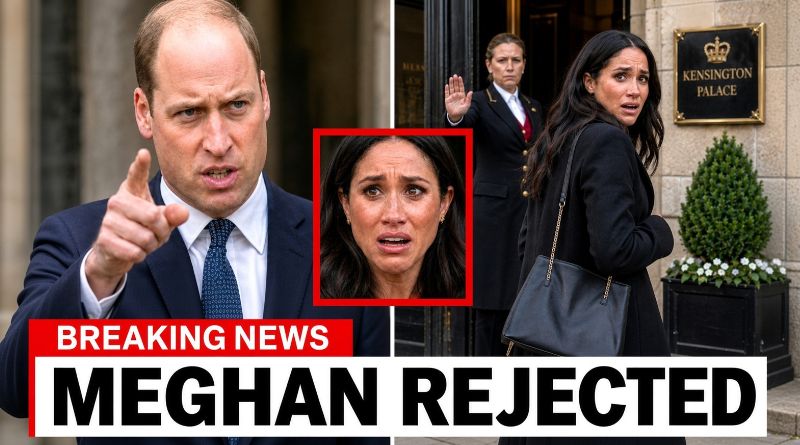
The video arrives with the urgency of a newsflash. Its title reads “2 MIN AGO Meghan’s Last Royal Plea REJECTED By William As Palace Confirms No Way Back,” borrowing the capitalisation and countdown of breaking news.
Within the opening minutes, the narration undercuts its own headline. The scenario is described as “this dramatized scenario,” then “this fictionalized palace confrontation,” then “in this dramatized account,” disclaimers that recur throughout.
Almost every substantive assertion is cushioned by “allegedly,” “supposedly” or “reportedly.” What is packaged as a palace exclusive is, by its own admission, a work of imagination.
The narrative itself is constructed with care. The commentary opens on the premise that Meghan — spelled “Megan” throughout the transcript — has spent years outside the royal circle “watching doors quietly close one after another.”
It then imagines a single private message sent “directly toward the heart of the monarchy,” described as “private, direct, and serious enough to move quickly through senior royal aids.” The segment stresses that this was not another interview or press statement, and that its quietness is what made it dangerous.
The alleged request is framed as modest. She was “not supposedly asking for money, titles, or a dramatic restoration,” the narration says, but for “communication reopened.”
The video claims softer approaches had already been tried through mutual contacts. What distinguished this one, it says, was its target: not the family in the abstract, but Prince William specifically.
From there the commentary builds its central mechanism, a distinction between forgiveness and access. William, it argues, could not weigh the request as a brother-in-law, only “as the future king.”
Advisers are said to have laid out everything that had happened since the Sussexes’ departure — interviews, public claims, Harry’s memoir — presenting it not as separate incidents but as one larger pattern. The identified palace fear is confidentiality rather than personal dislike, summarised as the question of “whether private conversations could ever again remain private.”
The narration adds a personal edge, claiming “conversations involving him had already become part of public narratives.” Its sharpest formulation is a pairing: “Forgiveness was emotional.
Access was political.” The segment then imagines advisers warning that no gesture could be made safely, because “a private invitation could be reported as a breakthrough” and “a ceremonial appearance might look like rehabilitation.”
It concedes an internal split, saying “some inside the family supposedly wanted the hostility to end” while fearing “peace without boundaries” more than continued conflict. A rhetorical flourish supplies the only number in the transcript: courtiers, it claims, “supposedly feared that one exception would create 10 new arguments.”
There is no list of ten details, claims or moments anywhere in the segment. The condition attached to the imagined proposal is the narrative’s turning point.
Meghan, the commentary says, wanted “a bridge back without surrendering the independent life built after leaving, creating a royal arrangement Britain had never comfortably understood.” That is glossed as selective appearances plus recognition that Archie and Lilibet still belong to a royal bloodline, even while living far from palace duty.
The narration frames her as asking whether the future had to remain trapped inside the past. It allows this to sound reasonable before turning on it: “Emotionally, the argument was powerful.
Institutionally, it was explosive.” The imagined objections are practical.
Would she attend major ceremonies, and could those appearances sit alongside commercial projects? What would happen to titles, security, publicity and international attention?
Most pointedly, “who would decide when a private family moment became a royal event”? The commentary also has William weighing the international reading, suggesting a symbolic welcome “could be interpreted far beyond Britain as an admission that the palace had been wrong all along.”
Any door opened for Meghan necessarily opens toward Harry, the segment argues, forcing the brothers’ unresolved conflict back into play with “no realistic arrangement” avoiding it. The refusal, when it comes, is framed as a boundary rather than a punishment.
Communication remains theoretically possible in the video’s account; a return to the inner circle does not. The imagined institutional principle is stated flatly: “There could be no return to royal privilege without royal responsibility.
No selective monarchy, no temporary comeback.” Advisers, the segment claims, then moved to harden that private position into something nobody could easily reverse.
In the account, the answer reaches Harry across the Atlantic, and he is left weighing three options: speaking publicly, staying silent, or making one final private approach. The video does not say which he chooses, and suggests William is building a monarchy with no meaningful place for him.
Its most ambitious claim is comparative. It contrasts this imagined William with Queen Elizabeth II, whose “era often left doors technically open,” against a successor moving toward fewer working royals and clearer boundaries.
A long closing passage turns to symbolism, arguing that “jewels matter because they are never merely jewels inside the monarchy” but represent “continuity, memory, rank, approval, and proximity to power.” It gestures toward items associated with Diana while conceding that “some possessions are private” and others “belong to larger royal collections.”
No specific piece is named, no collection identified, and no evidence is offered that anything has been withheld from anyone. Catherine, Princess of Wales, serves as the contrast case, moving “deeper into royal responsibility” while Meghan is placed outside ceremonies, invitations and the wider ceremonial structure.
The segment’s own summary of the distinction is that Meghan “may keep titles, memories, and a permanent connection to royal history,” but that these “are not the same as influence, access, or a place inside the machinery of monarchy.” It ends on generational consequence, suggesting Archie, Lilibet, George, Charlotte and Louis “could inherit relationships shaped by decisions made before they were old enough to understand them.”
Its final thesis is that the cruellest outcome is not scandal but silence — an institution continuing to function normally without her. None of this is sourced.
The transcript contains no dates, no named officials, no documents, no publication the claims trace back to, and no indication of whether the alleged message was a letter, an email or a conversation through an intermediary. No statement is quoted from William, Harry, Meghan or any representative of Kensington Palace or Buckingham Palace.
Whether King Charles was involved in or aware of the imagined decision is never addressed. The real material the dramatisation borrows from is thinner than the narrative implies.
Harry and Meghan announced their intention to step back from senior royal duties in January 2020, ceased working royal life that March and relocated to California. Their interview with Oprah Winfrey was broadcast in March 2021, and Harry’s memoir Spare was published in January 2023.
Diana, Princess of Wales, died in August 1997, when William was 15 and Harry 12. Catherine has held a senior working role for more than a decade.
Harry’s dispute over publicly funded security in the United Kingdom was rejected by the Court of Appeal in May 2025. Public reaction to this particular video cannot be characterised reliably, because no polling, press coverage or verified response to it has been documented.
The commentary does not report reaction so much as anticipate it, imagining William “imagining the headlines after the first appearance.” The genre it belongs to is large.
An extensive ecosystem of channels produces dramatised royal storylines at volume, typically using text-to-speech narration, stock footage, urgency-signalling titles and a recurring cast of the same handful of real people. Researchers who study platform monetisation have argued that such content occupies a grey zone, disclaiming fiction in the audio while marketing itself as news in the title and thumbnail, where most viewers decide whether to watch.
Supporters of the format describe it as speculative entertainment, no different in kind from historical dramatisation. Critics counter that the disclaimers sit where few will hear them, that the subjects are living people rather than historical figures, and that clips detached from those disclaimers circulate as fact.
Neither position has been tested in a British regulatory forum, since the content falls outside Ofcom’s broadcast remit and is governed instead by platform policy. Genuine questions about the monarchy’s future are being seriously reported: the trajectory toward fewer working royals, the practical limits of the Sussexes’ position, unresolved security arrangements and the long silence between the brothers.
Critics of the genre argue that dramatised content does not invent those questions but borrows them, supplying satisfying resolutions to disputes that remain open. Some of the segment’s observations about institutional logic are reasonable as commentary, particularly the point that proximity and permission are distinct from blood and title.
But an argument does not become reporting because it is plausible, and a scenario does not become a story because it is narrated in the past tense. The video’s closing line — that “the people pushed furthest from the throne often become the voices capable of revealing the most about it” — reads as a claim to insight.
On the evidence of the transcript, nothing was revealed.