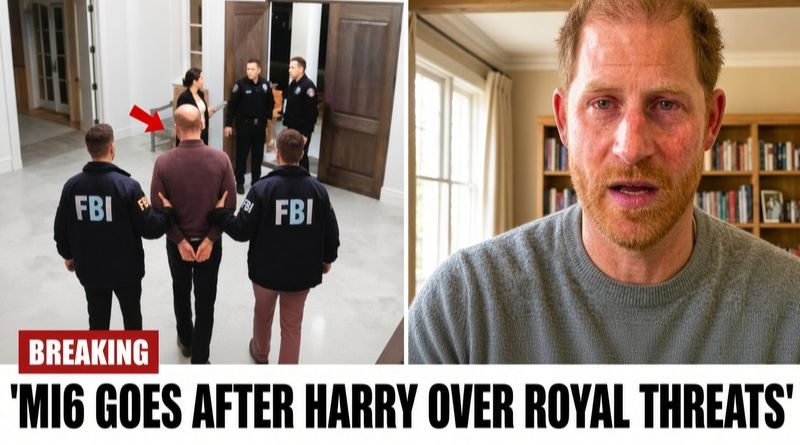
MI6 has reportedly been placed on heightened alert over an escalating royal standoff. The claim has circulated in commentary rather than through any named official confirmation.
It centres on allegations that Prince Harry is threatening to release what has been described as “bombshell royal secrets” unless he is allowed back into royal life. According to the commentary driving this story, the Duke of Sussex is not simply asking to return to the fold.
He is said to be using his own children, Archie and Lilibet, as a means of engineering a face-to-face meeting with his father, King Charles. That claim traces back to a Page Six report, which reportedly quoted sources describing Harry as “totally obsessed” with bringing Meghan and the children to spend time with the King.
The speaker calls the framing around it “Sussex propaganda,” while conceding Page Six is “a great publication with some fantastic journalists.” The commentary reinterprets that reporting more sharply, framing it as evidence that Harry is “weaponising” his children to force a reconciliation on his own terms.
The Page Six account, as described, refers only to a wish for the children to see their grandfather, not to any explicit threat. Layered on top of that is a graver allegation: that Harry has threatened to disclose secrets touching on “matters of state” and “intelligence operations” if his demands are not met.
The commentary caveats this claim directly, stating that these are “reports, not confirmed intelligence briefings.” No department, official or publication is named as the source for the MI6 alert itself.
The claim nonetheless forms the spine of the segment, with Vauxhall Cross, the real-world headquarters of the Secret Intelligence Service, invoked by name. The agency is described as the one “James Bond was loosely modelled after.”
Central to the narrative is the assertion that Prince William and Catherine, the Prince and Princess of Wales, have refused Harry’s demands outright. The refusal is rendered dramatically as “no, one word, two letters,” said to be “the most expensive syllable in the history of the House of Windsor.”
William and Catherine are described as prepared to absorb whatever follows rather than capitulate. Harry’s reported demands are described as threefold: security reinstated at working-royal level, a restored “place at the table,” and the substance of his HRH status returned even if not formally reinstated.
The commentary states plainly that this amounts to “blackmail,” and argues it “comes straight out of the Harry and Meghan playbook.” King Charles, 77, is portrayed as caught between anger at his son’s conduct and a more personal pull, including unhappiness that the couple have monetised their royal connections.
The commentary suggests the King is “battling cancer” and “craves seeing his grandchildren,” a combination it implies Harry may be exploiting. That reading of Charles’s private motivations is unverified and attributed to no source.
Harry, 40, is fifth in line to the throne and lives in a Montecito, California property the commentary describes as a $14 million mansion. To explain how the story reached this point, the commentary sets out what it calls a repeating four-step loop in Harry’s behaviour.
First, Harry makes a demand framed in the language of emotional need and family reconciliation, presented as a wounded son seeking the love of a father and brother he believes failed him. Second, the demand is not met on his terms; the palace moves slowly, the bureaucracy grinds, and the answer becomes “not yet” or “not like this.”

Third, he escalates, going to the press, to Oprah, to Netflix, publishing a book or leaking a detail, turning the private into the public and the personal into the profitable. Fourth, the cycle resets as damage is assessed, lawyers are consulted and PR teams respond, with Harry saying he was forced into the position by a family that refuses to listen.
The timeline the commentary uses begins in January 2020, when the “Megxit” announcement first broke. Public sympathy at that stage, it argues, was genuine, and the Queen’s statement at the time was gracious and measured.
That goodwill, the account continues, unravelled with the March 2021 Oprah Winfrey interview, in which Harry spoke of feeling trapped, described a lack of family support, and alleged his relatives would let situations “get really bad” before intervening. He also told Winfrey the institution was racist and that his father had stopped taking his calls, claims that remain among the most consequential and contested to emerge from the Sussexes’ break with royal life.
From there, the commentary traces a trail of commercial deals: a Netflix production agreement, a Spotify podcast contract, and the memoir Spare. Spare’s contents are cited repeatedly, including an alleged physical altercation with William, descriptions of private conversations with his stepmother, granular detail about Queen Elizabeth’s final days, and an anecdote about losing his virginity in a field behind a pub.
The commentary treats these disclosures as evidence of a pattern rather than genuine grievance, arguing that a man who felt truly silenced would not have become “the most interviewed man on the planet for three consecutive years.” A more recent flashpoint is a reported meeting between Harry and King Charles at Sandringham in September 2025.
Following that meeting, the commentary claims Harry went to the Guardian with details of the encounter, characterising the paper, without providing evidence, as one that “wants to shut down and abolish the monarchy.” No confirmation of what was discussed at Sandringham, or of who briefed the Guardian, is offered anywhere in the source material.
The MI6 angle is presented as the most serious and least scrutinised element of the story. The commentary argues that no member of the royal family has, in a thousand years of the institution’s history, threatened to compromise national security to resolve a personal dispute, comparing the situation unfavourably to the 1936 abdication of Edward VIII and to the Cold War-era Cambridge Five.
It also notes that the monarchy has previously survived the English Civil War, the Glorious Revolution, the loss of the American colonies, two world wars, the death of Diana and the Andrew scandal. It further claims the British government is “reportedly considering emergency legal measures” to prevent disclosure of classified material by a technically non-working royal, though no source, document or official is cited.
Legally, the commentary argues that if Harry does hold genuine classified material and is using it as leverage, that would ordinarily fall under the Official Secrets Act 1989, a law it says would trigger “immediate arrest and prosecution” for any other British citizen. It frames the absence of any such arrest as a product of “constitutional ambiguity” surrounding royalty rather than proof that the underlying allegation is untrue.
Whether Harry ever held a formal security clearance, and what obligations might have survived his military discharge and departure from royal duties, is not addressed with any specificity. A recurring point of fairness in the commentary concerns Harry’s military record, which it treats separately from the intelligence allegations.

He is acknowledged to have completed two tours of Afghanistan and trained as an Apache helicopter pilot, service described as “real,” “honourable,” and “the one unimpeachable pillar of his public identity.” The commentary states that this is “sacred” ground it will not cross, while maintaining that military service is not equivalent to intelligence clearance.
Running alongside the security allegations is a financial argument, offered as the underlying motive for Harry’s reported push to return. The Netflix relationship is said to have produced high initial viewership but “almost zero lasting cultural impact,” the Spotify deal is said to have been terminated after a single season, and Spare’s strong opening week is said to have given way to a “negligible” long-term footprint.
The commentary concludes that “the money is starting to slow down,” framing the reported desire to return as a response to fading commercial returns rather than genuine reconciliation. It also claims, without sourcing, that Harry now regrets Spare, the Netflix documentary in which it says Queen Elizabeth was mocked, and the Oprah interview, while adding that he likely does not regret the tens of millions of dollars those projects generated.
The commentary then sets out three problems it identifies with the strategy it attributes to Harry. The first concerns leverage.
It only works, the argument goes, when the other side cares more about what is threatened than the person making the threat, and here the calculus is said to run “exactly backwards,” because releasing state secrets would leave Harry, in the speaker’s words, no longer “a prince with a grievance” but “a traitor with a platform.” The second is that it misreads William and Catherine, who have already weathered the Oprah interview, Spare, the Netflix documentary and the leak cycle.
As the commentary puts it, “you cannot scandalise a population that has already read about your private life in a best-selling memoir.” The third is the MI6 dimension itself, which the speaker calls unprecedented, arguing there is no historical parallel for a reported intelligence alert prompted by a member of the royal family.
Public reaction, as characterised in the commentary, has shifted from the sympathy of 2020 to what is described as “bewilderment” and “a specific, quiet, deeply British form of embarrassment.” The public is described as exhausted, tired of the interviews and documentaries, and more likely to roll their eyes than gasp at a fresh disclosure.
A polling claim is made that sympathy for Harry has “collapsed to historic lows,” particularly among demographics that once supported him, though no pollster, date or figure is provided. The commentary also asserts that the British public is, for the first time in the entire saga, “standing behind” William and Catherine.

Harry’s planned July visit to the UK to promote the Invictus Games is folded into the same account of declining goodwill. Critics quoted in the segment describe the Games as facing serious public relations problems, with claims that costs exceed $100,000 per participant, that insufficient funds reach charitable causes, that injured veterans are “furious” the event has become centred on Harry and Meghan, and that sponsors are departing “left, right and centre.”
None of those figures or reactions are independently sourced within the material, and they should be treated as claims made in the commentary rather than established fact. A further claim extends the stakes to the Commonwealth, where the commentary argues Republican movements in nations including Canada, Australia, New Zealand and Caribbean states are gaining momentum, with Africa also mentioned.
Every high-profile disclosure from Harry, it argues, hands “ammunition” to those movements, an effect it calls “real,” “measurable” and “accelerating,” though this too is interpretation rather than documented political analysis. On precedent, the core argument is that refusing Harry protects the state, because negotiating with someone holding secrets hostage would, in the speaker’s framing, “transform the monarchy from an institution of stability into an institution of blackmail.”
The commentary is candid at points about the limits of its own certainty, repeatedly using “reportedly” and “allegedly” around the central claims of a threat, a raised MI6 alert level and a palace “in lockdown.” It also acknowledges more than once that the royal family is “not a warm, emotionally available group,” describing it as “a brand” and “a gilded machine” that has “historically chewed up sensitive individuals,” and conceding that media treatment of Meghan “had been appalling.”
Long stretches of the piece are addressed directly to Harry in the second person, which is rhetorical framing rather than reporting. Taken together, the claims sketch a royal family in a tense and unresolved standoff, but one built largely on unattributed reporting, inference and rhetorical framing.
No statement or denial from Buckingham Palace, Kensington Palace, representatives for Harry or Meghan, MI6, or any government department appears anywhere in the material, and no direct quotation of a threat from Harry is presented. What is documented is that the underlying tensions, over money, over access, over the children, and over the long shadow of the Oprah interview and Spare, remain unresolved more than five years after the Sussexes stepped back from royal duties.
The more serious allegations, particularly the alleged threat to national security, have not been confirmed, denied or clarified by any official source named in the commentary.