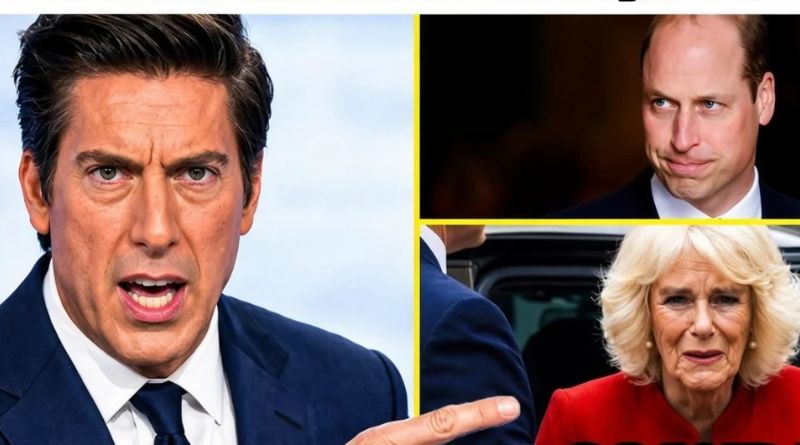
King Charles III allegedly signed an emergency succession dossier and handed full control of royal affairs to Prince William without public announcement, according to a video that has circulated online. The dossier, marked “ESD,” is described as a legal instrument normally reserved for illness, injury, or war, but the crisis that prompted it reportedly involved Queen Consort Camilla.
The video claims Camilla’s encrypted messages to a disgraced foreign diplomat from the early 1990s were uncovered by a Clarence House whistleblower. Documents linked to her initiatives vanished without a trace, and a royal archivist was dismissed.
A leaked video allegedly shows Camilla mid-argument with a senior adviser; it spread across the internet. Following the scandal, Charles summoned William for a private, unrecorded meeting and addressed him as “the one who must lead now.”
Charles then disappeared from the palace for three days, leaving late at night in a black vehicle with an undisclosed destination. The video asserts that staff began reporting to William, and one senior adviser said, “The king may wear the crown, but William is already ruling.”
Princess Anne reportedly told William: “You’re not preparing to lead anymore. You are leading.
And if you wait for permission, you’ve already failed.” Catherine, Princess of Wales, is described as a strategist who overruled suggestions of reconciliation with Camilla.
William drafted a confidential letter locking in the transfer and locked it away. The video presents five story segments: the silent transition, Camilla’s scandal, William’s rise, the monarchy’s struggle for survival, and Camilla’s secrets that shook the institution.
It claims suspicious financial transactions were traced to shell companies linked to the exiled diplomat. Camilla’s appearances were canceled, her aides reassigned, and her influence stripped.
None of these claims have been verified. Buckingham Palace, Clarence House, and legal representatives have issued no confirmation of any transfer of authority, secret dossier, encrypted messages, or financial impropriety.
The whistleblower remains anonymous, the diplomat’s identity undisclosed, and the location of the King unconfirmed. The video is an unsubstantiated online commentary that draws on public fascination with royal drama.
The video frames the transfer as a survival move for the monarchy, suggesting that Charles, now 76, was protecting the institution from collapse. It describes the emergency succession dossier as a tool designed for crisis, not for scandal.
Historically, such mechanisms are invoked during periods of incapacitation, not during a rumored marital or political affair. Camilla’s alleged scandal revolves around encrypted communications with a foreign diplomat who was exiled after a fallout with the crown in the early 1990s.
The video claims whistleblowers at Clarence House discovered the messages and turned them over to palace security. No evidence has been presented to support this narrative.
The video also alleges that Catherine played a behind-the-scenes role, coordinating with foreign leaders and rejecting offers to reconcile with Camilla. It describes her as a strategist who operated quietly but decisively.
Catherine has not commented on these claims, and no official source has corroborated her involvement. Princess Anne’s reported advice to William echoes her reputation for blunt, no-nonsense counsel.
The video places her in a shadowed library, speaking to William about leading without waiting for permission. Anne has not responded to the portrayal, which is typical for her in speculative content.
The transition is described as irreversible, with William drafting a confidential letter that locks the power shift into palace files. The video claims this letter was sealed and stored in a secure location.
No such document has been seen or authenticated by any independent party. Public reaction to the video has been mixed, with some viewers expressing shock and others dismissing it as baseless rumor.
Social media platforms have seen debates about the monarchy’s future, with hashtags calling for transparency. No official statement has been released to address the speculation.
Comparable cases include the abdication crisis of 1936, when Edward VIII stepped down to marry Wallis Simpson. That transfer was announced publicly and legally ratified.
The current video suggests a quiet, secretive shift, which has no precedent in modern British royal history. The video also draws on public memory of Diana, Princess of Wales, quoting her warnings about the “hidden machinery” of the palace.

Diana died in 1997, and her son William was 15 at the time. The video leverages that emotional connection to build credibility among viewers.
The disgraced diplomat mentioned in the video remains unnamed. The claims of shell company transactions labeled as philanthropic projects are vague and unsubstantiated.
Financial auditors have not confirmed any suspicious activity related to Camilla or the royal household. The leaked video of Camilla arguing with a senior adviser is described as having spread across the internet, but no such video has been verified by news organizations.
It may exist only as a claim within the video itself, without independent confirmation. The video’s five-part structure mimics documentary or news segments, which adds an air of authority to its claims.
However, the lack of citations, named sources, or official documentation undermines its credibility. It is best understood as speculative commentary, not journalism.
Royal experts have declined to comment on the video, citing the absence of evidence. One former palace staff member told a British newspaper that such accounts often blend real tensions with fiction.
The monarchy has weathered rumors for centuries, but this narrative lacks substantiation. The timeline in the video spans just a few days: Camilla’s scandal erupts, Charles calls a meeting, then disappears for three days, and William assumes control.
In reality, royal transitions take months or years of planning. The accelerated pace suggests dramatic license.
The video ends by inviting viewers to like and subscribe, indicating it is part of a content strategy designed for engagement. Similar channels have produced speculative content about the royals, tapping into ongoing public interest.
The claims should be treated with skepticism. None of the five story segments have been corroborated by any palace insider, court circular, or official press release.
The monarchy operates under strict protocols, and any transfer of authority would require legal and constitutional steps. No such steps have been reported.
The video’s assertion that Camilla’s initiatives were shelved immediately after the transition is plausible in the context of a palace reorganization, but no evidence of specific shelved projects exists. Her public engagements have continued, though at a reduced pace consistent with her age.
Catherine’s role as a strategist is a common theme in royal commentary, often highlighting her diplomatic skills. However, the video’s claim that she overruled reconciliation with Camilla is speculative.
The Princess of Wales has not publicly taken a stance on family matters. The confidential letter locked away by William is a dramatic detail, but no source has confirmed its existence.
Letters within the royal household are often privileged, but their content is rarely disclosed. This detail adds to the narrative’s intrigue without proof.

The video attempts to present a cohesive story, but it relies on anonymous sources and unverifiable events. It lacks the specificity needed for journalistic validation.
Readers should approach it as fiction or opinion, not fact. In summary, the video claims a secret power transfer from King Charles to Prince William, triggered by an uncovered scandal involving Camilla.
No official confirmation exists. The royal household continues to operate under existing protocols, with Charles still performing official duties.
The story remains unsubstantiated. The broader context of online royal speculation matters because it shapes public perception and fuels media cycles.
Similar videos have previously claimed Queen Elizabeth II was stepping down or that Harry and Meghan were planning a coup. None of those proved true.
The monarchy’s own communications have remained consistent. The official website lists Charles as sovereign, William as heir apparent.
Court circulars show Charles undertaking engagements, including audiences and diplomatic meetings, in recent weeks. Social media algorithms amplify dramatic narratives, especially those involving scandal and succession.
The video’s title alone — “King Charles Gives William FULL CONTROL After Camilla’s Scandal EXPLODES” — is designed to attract clicks and shares. For viewers unfamiliar with royal protocols, such content can appear credible.
But the absence of named whistleblowers, verifiable documents, or independent reporting should raise red flags. Responsible coverage requires corroboration from multiple sources.
The video also ignores the constitutional reality of the British monarchy. The sovereign’s authority is not transferable by a single dossier; it requires legislation or a formal abdication, which would involve Parliament.
No such process has been initiated. Legal experts note that an “emergency succession dossier” is not a recognized constitutional instrument.
The term appears nowhere in official royal records or parliamentary documents. It is likely a fictional device.
The mention of a “foreign diplomat from the early 1990s” ties into historical rumors about Camilla’s past, but those rumors were never substantiated. The diplomat remains unnamed, making the claim impossible to verify.

Financial transactions through shell companies are a serious allegation that would normally trigger a police investigation. No report of such an investigation has emerged.
The Metropolitan Police have made no statement regarding the royal household. The leaked argument video is described as having gone viral, yet no major news outlet has reported seeing it.
Its existence may be part of the video’s internal narrative rather than an actual recording. The video’s reliance on an anonymous whistleblower is a common trope in speculative content.
Without the whistleblower’s identity or testimony under oath, the claims cannot be tested. Princess Anne’s blunt quote, while in character, is unattributed to any interview or memoir.
It reads as dramatic dialogue written for effect. The portrayal of Catherine as a cold strategist overruling reconciliation is at odds with her public image as a unifying figure.
It plays into divisive narratives that have little basis in documented behavior. The video’s five segments mirror the structure of a mini-documentary, which may mislead viewers into thinking it is researched.
In reality, each segment makes claims that depend on the previous one, creating a circular logic. The monarchy has faced genuine scandals in recent years, including Prince Andrew’s legal troubles and the Sussexes’ criticisms.
Those events are well-documented and subject to official responses. This video’s story does not fit that pattern.
Without any official comment from the palace, the story remains in the realm of speculation. The royal family’s press office routinely refutes false claims, but has remained silent on this one, suggesting they regard it as beneath response.
In conclusion, the video presents a dramatic but unsubstantiated account of a power shift within the British monarchy. Its claims lack verification, its sources are anonymous, and its timeline is implausible.