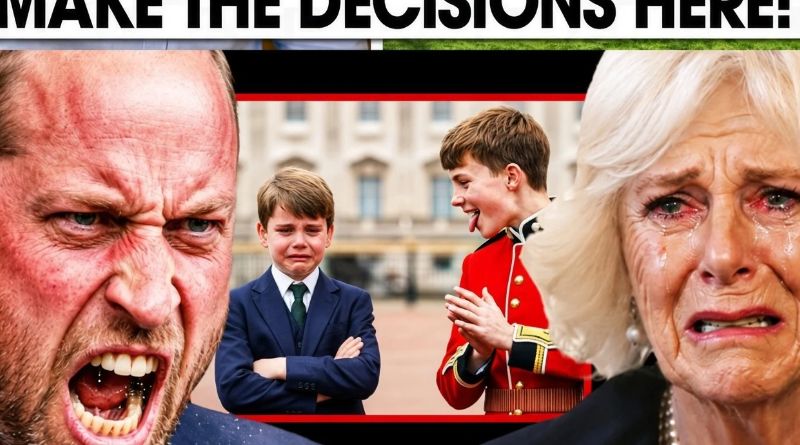
A widely shared video feature alleges that Prince William quietly moved to reshape the royal family after an incident at Balmoral. The account, presented as narrated commentary rather than a formal journalistic investigation, says Queen Camilla’s grandchild made comments to Prince Louis that were described as “deliberately cruel.”
The remarks reportedly aimed at Louis personally and also referenced Catherine, Princess of Wales, and invoked Diana, Princess of Wales. Louis reportedly burst into tears and ran straight back to his mother.
Balmoral is central to the story because it is the royal family’s private retreat, with no framework of official duties. The video argues that an emotional wound there carries extra weight because no formal routine contains it.
The Scottish estate has been the backdrop of royal summers since Queen Victoria and Prince Albert acquired it in 1852. It is personally owned by the monarch rather than the state, and the late-summer gathering at the estate is one of the most predictable rhythms of royal life.
It was at Balmoral that Queen Elizabeth II spent her final days and died in September 2022. The estate’s private character means that what happens there rarely becomes public, which is part of why an alleged break in that privacy carries such force.
The press has long observed an unwritten rule around the estate, with photographers kept at a distance and the family’s movements reported only in the vaguest terms. This protective bubble is part of why unconfirmed internal stories from Balmoral circulate with unusual weight when they surface.
According to the account, Catherine went “completely still” rather than making a scene, and staff noticed a “tangible” shift in her demeanor. She reportedly stayed visibly composed but decided not to let the incident pass.
That evening, in a private conversation with William, Catherine reportedly invoked Diana and said she would not allow history to repeat itself for George, Charlotte, and Louis. The video describes that as the moment William stopped managing the situation and started planning a response.
The next morning, Kensington Palace held a closed-door meeting with senior aides and legal advisers without advance notice, the video claims. William reportedly walked in with a briefing folder laying out a methodical plan to reduce Queen Camilla’s extended family’s role in royal life.
Staff members reportedly began calling the effort “the eraser mandate,” a phrase that does not appear in established royal reporting. The novelty of the term suggests it comes from internal commentary rather than from any confirmed palace document.
According to the report, William bypassed King Charles III and informed him in writing after the decision was already set in motion. The letter was said to be respectful in tone but functioned as a notification, not a request for input.
If accurate, that detail would mark a striking break with royal tradition. The monarchy’s hierarchy runs downward from the sovereign, so a senior royal acting without consulting the king first would be regarded inside the palace as a significant procedural breach.
Camilla reportedly tried to persuade Charles to reverse the decision, arguing that the proper chain of authority had been bypassed. The video claims Charles chose not to overrule his son.
The consequences, the video says, were concrete, with routine invitations and appearances for Camilla’s extended family stopped. Their integration into royal public life was unwound, although the report gives no list of specific events, invitations, or roles that were cut.

Long-serving palace observers had already quietly worried about how often Camilla’s relatives appeared in royal settings, the report says. The video claims no quiet walkback or compromise followed, and the directive held as William constructed it.
Camilla’s extended family is, in fact, a visible presence in royal ceremonial life, even though none of its members is a working royal. The queen has two children from her first marriage to Andrew Parker Bowles, which ended in divorce in 1995.
Her son Tom Parker Bowles works as a food writer, while her daughter Laura Lopes works in the art world. Neither carries a royal title, yet the wider family has appeared at some of the monarchy’s most watched moments.
Several of Camilla’s grandchildren were part of the wedding party when William and Catherine married in 2011, and members of the family have joined balcony appearances on major occasions. These appearances have long produced private grumbling and public debate about where family ends and institution begins.
When Charles became king, there was widespread speculation about whether Camilla’s children and grandchildren would be given formal roles or titles. No such roles materialized, but the family’s presence at ceremonial events continued.
Public reaction, according to the video, was emotional rather than gossip-driven, with social media filling with old footage and photographs of Diana. The public reportedly connected the reports to the historical criticism that the institution failed to protect Diana and to William’s determination to protect his own children.
Diana remains a defining figure for William in ways he has acknowledged publicly. He was 15 when she died in a Paris car crash in August 1997, and he has spoken over the years about the importance of shielding his own children from the pressures that shaped his early life.
Diana’s own experience inside the institution included public scrutiny and a hostile press, and her 1995 BBC interview laid bare the unraveling of her marriage. In that interview she famously said, “There were three of us in this marriage.”
That history gives Catherine’s reported invocation of Diana its power. The claim that she told William she would not allow history to repeat itself turns a family dispute into a generational reckoning with the institutional past, a narrative reinforced by Netflix’s dramatization of Diana’s story in “The Crown” and by the devotion of her fan base online.

The video frames the episode as a defining moment connected to Diana’s legacy, Catherine’s influence, and William’s emerging leadership style. It describes William as warm in public but firm and private, unwilling to let institutional patterns repeat.
The report also sets the alleged decision against a backdrop of royal instability. Charles has been undergoing treatment for cancer since his diagnosis was announced in February 2024.
The monarchy has also been managing the fallout from Prince Harry and Meghan Markle’s departure from royal duties in 2020, their public interviews, and Harry’s memoir “Spare,” published in January 2023. The video suggests Charles’s weariness with family conflict made him unwilling to pick another fight with his eldest son.
William has shown a willingness to act decisively before. He was central to the so-called Sandringham summit in January 2020, during which Charles presented a plan governing Harry and Meghan’s exit from royal life.
The same instinct is visible in how the Wales household manages the children’s public exposure. William and Catherine release controlled photographs and limit appearances, a deliberate departure from the more exposed royal upbringing William experienced.
The video also says the monarchy’s center of gravity has shifted toward the Wales household. It notes that William and Catherine have built strong public trust, which opinion polling consistently confirms, with the couple regularly ranking among the monarchy’s most popular members.
Courtiers, the report says, began recalibrating and orienting themselves toward William and Catherine after Charles declined to intervene. If true, that would reflect a natural dynastic process in which power moves toward the next generation before the crown actually changes hands.
A dynastic shift of this kind would carry a personal cost for Camilla. It would signal that her family’s carefully managed integration into royal life had been reversed by her stepson, a break that would be hard to repair.
None of this can be verified. The entire account rests on unnamed insiders and sources described as close enough to witness the exchange, and the video provides no documentation, no named witnesses, and no official confirmation.

No date or year is given for the Balmoral gathering. The narration describes Louis as seven years old, which, given his birth in April 2018, would place the alleged events in 2025 if that detail is accurate.
The identity and age of Camilla’s grandchild are not provided, and the specific words allegedly said to Louis are never stated. Neither Kensington Palace nor Buckingham Palace has confirmed any part of the narrative.
The report also does not say which specific events, balcony appearances, or ceremonial roles were cut, or whether the reduction is permanent. The video says the effects are still unfolding today, without giving a timeframe.
The video’s broader conclusions about William’s future kingship are commentary and analysis, not verified fact. It sits within a crowded genre of royal commentary that thrives on anonymous sourcing and dramatic framing.
The institution’s traditional “never complain, never explain” stance means these stories rarely meet an official correction. Recent royal controversies, from the fallout over Omid Scobie’s book “Endgame” in 2023 to the manipulated photograph of Catherine released in March 2024, show how quickly unconfirmed palace narratives spread before any official response.
Readers are therefore left with a story that cannot be confirmed or fully dismissed. What remains is a narrative about protection, family, and the generational transfer of power inside the world’s most scrutinized institution.
The report’s lasting image, it argues, is a small boy running back to his mother. That image, whether or not the surrounding account is true, is why the story is unlikely to disappear.