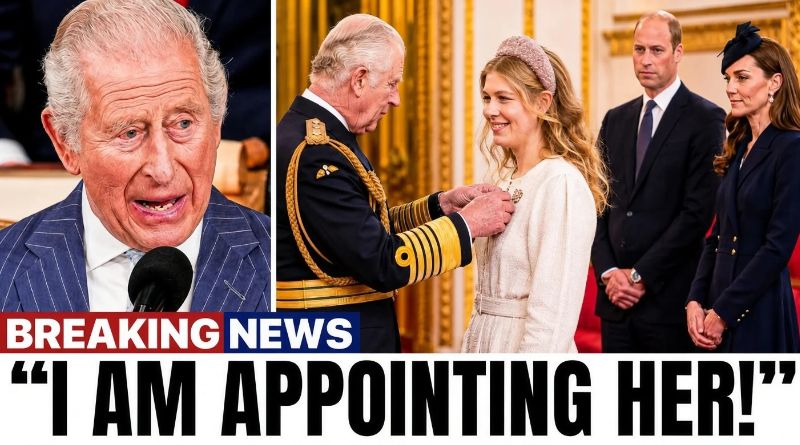
A digital commentary circulating widely on social media is asserting that King Charles III has quietly appointed Lady Louise Windsor to a role of significant constitutional weight, a move the video frames as one of the most consequential personnel decisions of his reign. The claim has not been confirmed by Buckingham Palace and remains, for the moment, in the realm of online analysis rather than official announcement.
The video argues that the decision reveals a tightly drawn circle of trust that includes Princess Anne, Prince Edward, and now Louise, while conspicuously excluding Queen Camilla from the inner governance layer. It also presents the appointment as a deliberate redistribution of administrative responsibility away from an already-stretched Prince William.
To understand the framing, one must first understand the pressures the monarchy is currently operating under, according to the commentary. King Charles has been notably transparent about his health situation since beginning cancer treatment in early 2024, a level of openness that departs sharply from the historic reticence of the British crown.
The video argues that this transparency has generated a reservoir of public goodwill, but it has not solved the underlying governance problem: the machinery of state continues to function even when the monarch is unwell. State papers still require review, intelligence briefings still require clearance, and royal duties still require execution, the commentary notes, creating a structural need for trusted stand-ins.
The obvious candidate, the video concedes, is Prince William, the heir apparent and a man who has taken on an increasing share of public-facing duties since his father’s diagnosis. But William is described in the commentary as unable to absorb additional administrative weight without significant personal cost.
Catherine, the Princess of Wales, has been navigating her own recovery from cancer, announced in March 2024, and the couple’s three children, Prince George, Princess Charlotte, and Prince Louis, require a present and engaged parent. Layered onto that is the psychological burden of preparing for a kingship that now appears closer than once assumed, the video argues.
Charles, the commentary suggests, is unwilling to break his son and has therefore looked elsewhere, finding an unlikely figure in his 21-year-old niece. The reaction the video claims to have captured from the wider royal household is one of stunned silence, though it offers no specific sourcing for that characterization.
Lady Louise Windsor’s name, until recently, circulated mostly within royal-watching circles and carriage-driving enthusiasts, the latter being a sport in which she has competed competitively at national level. She is the elder child of Prince Edward, now Duke of Edinburgh, and Sophie, Duchess of Edinburgh, the sister-in-law of the King.
Born on 8 November 2003 at Frimley Park Hospital, Louise arrived with a condition called esotropia, a form of eye misalignment that required significant medical intervention in her earliest years. Her parents made a deliberate decision to raise her and her younger brother, James, Viscount Severn, outside the intense glare of the royal press, a choice that has had lasting consequences for their public profile.
When Louise came of age, the family engaged in what the video describes as genuine deliberation about whether she would take on working royal duties or step back into private life. Louise chose the public role, and went on to read English at the University of St Andrews, the same institution where her cousin William met Catherine in the early 2000s.

The video emphasizes that Louise and her brother declined the automatic titles of princess and prince, a right they held under the 1917 Letters Patent issued by George V but chose not to exercise. That decision, the commentary argues, is now being read as a powerful statement of values, signaling a generation of royals unencumbered by the expectations of birthright.
The video characterizes Louise as a figure without dynastic ambition, a quality it presents as a virtue rather than a liability in the current palace environment. This framing places Louise alongside Princess Anne, whom the commentary describes as perhaps the most trusted figure in Charles’s inner circle.
Anne’s standing, the video argues, derives from a structural fact: she has no path to the throne and therefore no incentive to manipulate the system in her own favor. The comparison to Anne is offered as a deliberate model, with the video drawing a line from Elizabeth II’s quiet cultivation of her daughter to Charles’s apparent cultivation of his niece.
Central to the commentary’s argument is the claim that Queen Elizabeth II laid the groundwork for Louise’s elevation through a 2022 amendment to the Regency Acts. Counselors of state historically have included the sovereign’s consort and the first four adults in the line of succession, a formula that has been criticized for excluding experienced working royals in favor of distant heirs.
The Regency Act 2022, which received Royal Assent earlier that year, permanently installed Anne and Edward in that role for life, broadening the bench of senior royals who can act on the monarch’s behalf. The video uses that move as the foundation for its larger claim about Louise, suggesting Charles is completing a constitutional strategy begun under his mother.
Where the video sharpens into more contentious territory is in its characterization of Queen Camilla’s position within the inner circle. According to the commentary, Camilla is being excluded from the actual governance circle and does not receive the briefings or sign the legislation that the working members of the family handle.
This, the video argues, is widening the gap between Camilla’s formal title as Queen Consort and her practical influence within palace decision-making. No official statement from the royal household supports or refutes this characterization, and the video’s claim should be read as interpretation rather than reportage.

The commentary goes further, alleging that William and Catherine actively support Louise’s elevation, viewing it as a way to distribute the institutional pressure now concentrated on the Wales household. This support, the video suggests, aligns the Wales and Edinburgh households in a way that has not been visible in recent palace politics.
The broader public response, as described by the video, is one of cautious but genuine optimism, grounded in Louise’s relative anonymity and her choice to forgo automatic titles. Royal watchers cited in the commentary describe that choice as a quiet rebuke of the title-obsessed culture that has shadowed the family since the era of Diana, Princess of Wales.
The video also notes the role of social media in shaping the reaction, with younger audiences particularly responsive to Louise’s image as a working royal who earned her position rather than inheriting it. Countervailing pressure, the commentary warns, may come from the so-called palace old guard, the senior courtiers and household officials whose institutional standing depends on the existing distribution of power.
The video suggests these figures may quietly obstruct or delay the implementation of Louise’s role, a pattern it claims has accompanied previous modernization efforts within the monarchy. Historical parallels exist for exactly this dynamic: the accession of Queen Elizabeth II in 1952 was followed by a slow displacement of the old court establishment that had served her uncle Edward VIII and her father George VI.
Charles himself, when Prince of Wales, frequently clashed with the palace’s traditional household, a tension that the video reads as precedent for the current situation. The Regency Act framework itself, first enacted in 1937 and amended repeatedly, was designed to address a similar problem: how to keep the constitutional functions of the monarchy operating when the sovereign is incapacitated.
In the nineteenth century, the Regency of George, Prince of Wales, governed on behalf of his father George III during the king’s well-documented illness, establishing a precedent that modern statute law codifies. The Regency Act 1943, passed during the Second World War, similarly allowed Princess Elizabeth to act as a counselor of state on behalf of her father, a precedent the 2022 amendment extends.
What remains unclear, and what the video does not resolve, is the exact nature of the role Louise is said to have been given. The commentary uses the phrase “regent-adjacent” without specifying whether it is a formal constitutional position, a household appointment, an advisory capacity, or a working royal assignment.

No official press release from Buckingham Palace has confirmed or denied the appointment, and the Palace has not commented on the video’s central claim. The video’s claims about senior royals being “stunned into silence” are similarly unsourced, presented as the commentator’s reading of body language and absence of comment at recent official engagements rather than as reported fact.
The degree of William and Catherine’s support is inferred, the video acknowledges, from proximity and the absence of public objection, not from on-the-record statements. Claims about internal palace reaction, tension with Camilla, and obstruction by courtiers are framed throughout as analysis rather than verified reporting.
The commentary’s most concrete factual anchor remains the 2022 amendment to the Regency Acts, a real legislative event whose implications the video extrapolates into a larger narrative. Whether that extrapolation will be borne out by events remains to be seen, and any meaningful assessment will require confirmation from official palace sources.
For now, the story exists primarily as viral commentary, the kind of online royal analysis that has grown rapidly in scale and influence since the early 2020s. The structural conditions it identifies, however, are real: a king in treatment, an heir under pressure, a working royal bench that has thinned since the departures of Prince Harry to California in 2020 and Prince Andrew from public duties in 2019.
Into that gap, the video argues, Charles has chosen to elevate a young woman trained to expect nothing and prepared to do the work. Whether that bet pays off will be measured less in headlines than in the quiet functioning of an institution older than any of the figures it surrounds.