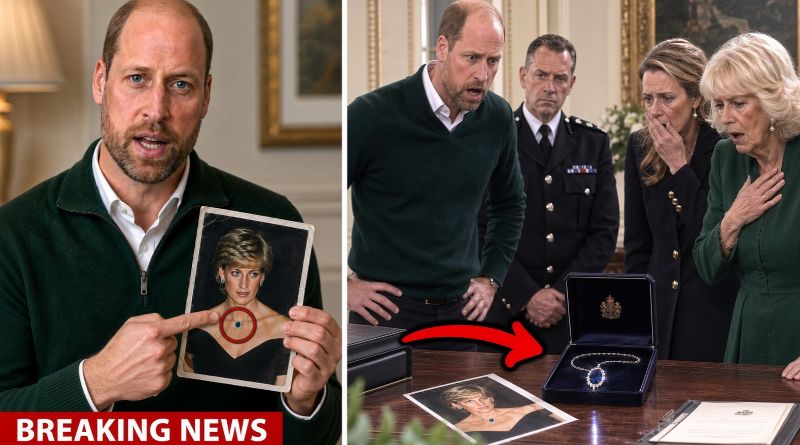
A claim now circulating on YouTube alleges that Prince William quietly moved against Queen Camilla’s daughter, Laura Lopes, over two pieces of jewellery linked to Diana, Princess of Wales. The allegation comes from a channel called Mark Holden Reports, presented by commentator Mark Holden.
None of it has been confirmed by Kensington Palace, Buckingham Palace or Clarence House. Holden frames the story around what he calls a “hook”: a leaked Ministry of Justice file that he says lists 14 missing royal artefacts, not the two he claims were recovered.
According to the video, the sequence began when a black diamond pendant on a fine chain and a sapphire bracelet were consigned to an unnamed London auction house under Laura Lopes’s name as ordinary estate jewellery. The presenter says a member of the valuation team recognised the pieces from press photographs of Diana wearing both in the late 1980s, images he describes as retrievable by anyone with an archive login.
He claims the consignment carried nothing flagging royal history. Because the items had sat outside any modern royal inventory for 25 years, he argues, no current document tied them to the royal collection — in his words, “an object with no paper attached to it belongs to whoever is holding it.”
That is the mechanism at the centre of his account. A dated catalogue entry from a globally recognised auction house would itself have created a paper history establishing private ownership, he argues, and a completed sale “looks like nothing.”
Holden notes that where the jewellery went after Diana’s death has never been settled publicly, and that her personal collection is widely reported to have passed to her sons, with Catherine and Meghan both photographed wearing pieces from it. The specific claim that these two items passed to Camilla’s side of the family in the 1990s, that William raised the matter with her as a teenager, and that an unwritten understanding kept the pieces locked away for more than 25 years, is presented by Holden himself as long-circulating secondhand accounts rather than documented fact.
Once the consignment images allegedly reached contacts inside Kensington Palace, the video claims William bypassed Clarence House, cleared his diary and instructed the law firm Farrer & Co, a real firm with longstanding ties to the royal household. In Holden’s framing, “ringing Farrer means you have already decided.”
The instruction he is said to have given was threefold: classify the jewellery as part of Diana’s estate, block any valuation from proceeding, and begin recovery. Holden calls that reclassification “the single most consequential thing anybody did in this entire story,” because it recasts a private family dispute as a civil claim over misappropriated property that can reach the High Court within days rather than months.
The commentary then widens the timeline. It claims that months earlier, in a May whose year is not specified, William withdrew roughly a fifth of the Duchy of Cornwall’s commercial property portfolio, valued at around £500 million, from the active market.
The Duchy is a genuine, publicly documented estate that funds the heir to the throne, is worth roughly £1 billion and publishes annual accounts. William did inherit it in September 2022 when his father became king, a fact that sits apart from the unverified elements of the story.
The video alleges the withdrawn assets included private trusts and funds that had been channelling money to Camilla’s extended family for roughly two decades, according to leaked paperwork Holden describes but does not produce. The public explanation given at the time, he says, was community reinvestment and housing.
Holden argues that advisers warned William the closures would be read as a declaration and would cause serious institutional disruption. William’s reported response was that the Duchy’s resources exist to serve the public and the institution, not private interests.
The presenter says he checked the dates himself and found the widely circulated version had the order backwards: on his account the Duchy move came first and the jewellery consignment second, making the jewellery a justification to accelerate a campaign already underway rather than its cause. The account’s most striking claim concerns a meeting at Sandringham, where William is said to have presented King Charles with a leather binder containing draft letters patent on “asset reclassification.”

According to the video, the framework would allow the heir apparent to petition the Privy Council if the reigning monarch could not adequately safeguard the crown’s historical assets, including by reason of declining health. Holden links that clause to Buckingham Palace’s confirmed February 2024 announcement of the King’s cancer diagnosis.
The commentary claims Charles signed rather than risk a public dispute over his own capacity. Holden stresses the mechanism would not remove a king or touch the throne, the succession or any ceremonial function, only the control of one category of property.
From there, the video says the two pieces were reclassified as crown property held for the direct line of succession rather than the sovereign’s household, permanently excluding Camilla’s side of the family. The claimed legal action escalated on 23 May, when lawyers acting for William’s interests are said to have obtained a High Court freezing injunction against Laura Lopes, locking every account, holding and trust connected to her name.
Freezing injunctions are among the most stringent instruments in English civil law, requiring a court to be satisfied there is a genuine risk assets will otherwise disappear. Holden uses that real legal threshold to argue the order must have been unusually well prepared, and says alerts went to banks so quickly that her financial life stopped functioning that afternoon.
The video then describes a pre-dawn arrival at Laura Lopes’s Wiltshire home at around 5am on 24 May, executed under a civil search order rather than any criminal warrant, with no arrest made and no charge brought at any point. The pendant and bracelet are said to have been found, catalogued and logged with what Holden calls “an unusually careful chain of custody.”
He argues that the preparation — the order, the timing, the documentation standard and a list naming exactly two items — reflects weeks of legal work that “did not start when somebody spotted a photograph.” Pre-dawn execution, he says, is standard practice to reach a person before they can contact a solicitor or move items.
On Holden’s account, Laura Lopes had no practical way to contest it: frozen accounts, no friendly press after two decades of avoiding it, and no institutional protection because she holds no institutional role. The commentary claims Camilla was blindsided, and that her lawyers were asked whether sovereign immunity could extend to her daughter.
They reportedly advised that the protection attaches to the reigning monarch and, more narrowly, to the Queen on official duties, not to adult children holding no public position. Buckingham Palace’s press office was allegedly instructed to issue nothing without Kensington Palace’s approval.
Confidentiality orders reportedly barred several outlets, including financial publications, from linking the asset freeze to the jewellery. Holden argues that financial journalists cannot be steered by press offices, so closing that route required legal orders — which he presents as evidence of planning rather than reaction.

He also credits Camilla directly, noting she arrived as the most disliked public figure in Britain and spent two decades rebuilding her position through discretion. His claim is that the narrative-management route was closed before she could use it.
None of these instructions, orders or reporting restrictions have been independently verified, and no named lawyer, court official or palace spokesperson is cited anywhere in the account. Court documentation is said to show a broader review opening on 14 June, with findings the video claims went well beyond the two recovered items.
By June, according to the video, Laura Lopes had signed away any claim to the jewellery in exchange for limited access to her own frozen funds for legal and administrative costs. Holden says there was no settlement in her favour and none of the face-saving language that usually appears when both sides hold leverage.
William is then said to have issued a short Kensington Palace statement referring to his mother’s legacy not being “bargained over” and to a boundary having been set, naming no one. The final claim is the establishment of a “Diana Heritage Trust,” which the video says placed every documented piece of Diana’s jewellery still within reach under terms naming Catherine, Princess of Wales, and after her Princess Charlotte, who is 11, as beneficiaries.
Under the reported terms, the structure bypasses the sovereign’s household and includes built-in succession mechanisms intended to keep operating for decades regardless of who holds authority. Holden argues this element turns the episode from a settled dispute into a durable transfer of control over Diana’s legacy to people not yet in positions of authority.
The video’s central hook returns at that point: a leaked Ministry of Justice file said to list 14 documented artefacts missing from a repository at Highgrove, of which only two were recovered in Wiltshire. The remaining 12, according to the claim, had already left the country and were traced to an anonymous holding company registered in Delaware.
The video notes Delaware is commonly chosen for corporate secrecy that makes disclosure or repatriation difficult for a foreign court to compel, which Holden reads as evidence that advice was taken well before the consignment. Investigators are said to have attached the internal code name “the Montecito connection” to whoever they believed was coordinating that wider movement.
Holden is explicit that a code name is not an identity, a finding, a charge or evidence, that nobody has been named or accused in any court, and that he does not know who it refers to. He adds only that Montecito is a small town in California.

He also raises, as speculation, the possibility that the volume of leaks suggests someone inside wanted certain details known. Holden’s own framing is that the absence of public reaction is the point.
Confidentiality orders limited serious outlets, Laura Lopes said nothing and Camilla had no channel, so on his account there was no visible row to report. Response to the video itself has reportedly centred on the unresolved fate of the 12 missing pieces, a question Holden puts to viewers and says he has not answered himself.
Mainstream royal correspondents and legal commentators have not addressed these specific claims, and no British newspaper appears to have reported an injunction, a Wiltshire search order, a Sandringham signing or a Delaware entity connected to this story. Some observers have pointed out that a High Court freezing order against the Queen’s daughter, letters patent altering a monarch’s authority over assets, or a dawn civil search order would ordinarily leave court listings, case numbers and documentary trails that reporters could locate.
Holden acknowledges the gap repeatedly. He states that nobody has been charged, that no court has found Laura Lopes to have done anything wrong, and that central details rest on leaked documents and secondhand accounts no one in the family has confirmed.
He also offers what he calls “the fair version”: that Laura Lopes is a private citizen who takes no public money, and that selling inherited jewellery through an auction house is unremarkable. He concedes that reading holds up better than the tellers of the more dramatic account admit, while saying he leans toward the harder version.
The well-established elements are the background ones — the Duchy’s public accounts and William’s 2022 inheritance, the February 2024 cancer announcement, Farrer & Co’s long relationship with the royal household, and Diana’s jewellery having been publicly worn by Catherine and Meghan. Camilla’s public rehabilitation over two decades, from one of Britain’s most unpopular figures to her coronation, is also documented, and the video leans on it to explain why a communications blackout would matter to her.
Until a court record, a palace statement or an on-the-record legal source surfaces to confirm any part of it, from the auction consignment to the Delaware entity, the account remains an unverified claim from a single YouTube commentary channel rather than an established news event.