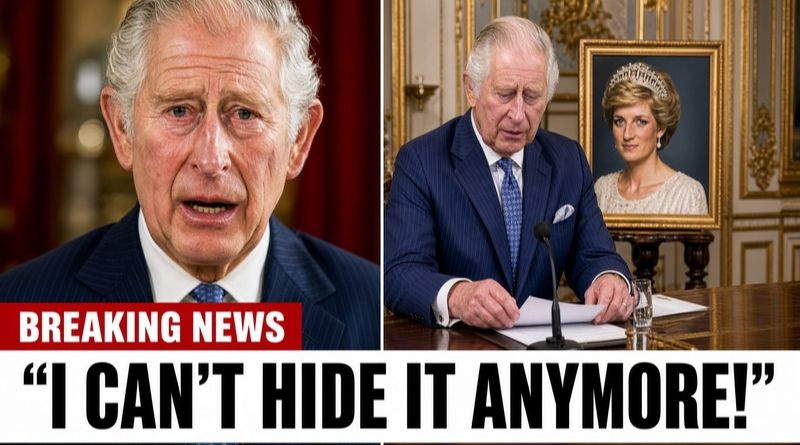
A video circulating online has made a striking claim: that King Charles III privately broke decades of royal silence to admit his late first wife, Diana, Princess of Wales, was “deliberately isolated” after she challenged senior courtiers. The clip, structured as a multi-part suspense narrative, frames this as a suppressed royal secret rather than confirmed reporting.
It repeatedly hedges its own claims with words like “allegedly,” “reportedly,” and “according to the story.” No news outlet, biography, palace statement, or historian is credited anywhere in the segment.
At the centre of the narrative sits an alleged private palace meeting that the video says “unexpectedly became public,” though no date, location, or attendee list is offered. According to the account, this is where Charles is said to have acknowledged that Diana was pushed to the margins of royal life after crossing senior aides.
The video also claims that old palace correspondence had been reviewed before this alleged statement emerged, though by whom and under what authority is never specified. That detail matters because it implies institutional involvement rather than a spontaneous personal remark, yet no documentary evidence is offered to support it.
The narrative’s most dramatic element is a supposed confidential letter, said to have been written by Diana to Charles shortly before her death in August 1997. The video claims this letter was preserved somewhere in royal records, without identifying which archive or institution supposedly holds it.
The segment then alleges that the letter’s final page is missing, a gap it frames as the crux of the whole story. That missing page, the video claims, once named a person Diana purportedly believed was “secretly working against her.”
It never suggests who that person might be. The framing of the word “isolated” does a great deal of work in the narration, which stresses that isolation need not mean physical solitude.
A person can be surrounded by advisers, officials, family, and reporters, the narration argues, while still being cut off from the decisions shaping her life. That is a rhetorically effective distinction, but it is also an unfalsifiable one, which is part of why the claim is difficult to test against any record.
The material itself begins in a way that deserves scrutiny, opening with language that closely mirrors Charles’s first televised address as King in September 2022, following the death of Queen Elizabeth II. Those lines, describing a life well lived and a promise with destiny kept, were delivered about his mother, not about Diana, yet they are positioned at the top of a segment promising revelations about his first wife.
Public reaction to the claim cannot be independently verified, since the video solicits engagement rather than reporting genuine audience response. Viewers are urged to comment “yes or no” on whether they would want to know Diana’s supposed final message, a device more typical of engagement-driven content than investigative journalism.
Media analysts who study viral royal content note that this kind of prompt, paired with cliffhanger structuring, is designed to maximise watch time rather than to deliver verified news. Commentators sceptical of unverified royal content argue that the absence of any named source, whether a courtier, biographer, or official record, is itself a significant warning sign.
Those more sympathetic to the account point out that royal archives are notoriously opaque, and that sensitive material involving Diana would plausibly be kept from public view regardless of whether this particular story is accurate. There is a factual basis for the opacity argument, at least in general terms: the Royal Household is not subject to the United Kingdom’s Freedom of Information regime in the way government departments are.
That means claims about what does or does not sit in royal records are unusually hard to check, a gap that speculative content can exploit without ever being conclusively disproved. Observers within royal reporting circles would likely add that Diana’s fraught relationship with courtiers is well documented, even if this specific letter and missing page are not.

A further element in the video concerns Prince William, who is said to have opposed reopening the subject of his mother’s final years. The video frames his alleged resistance as rooted in concern that renewed scrutiny could reopen wounds that have never fully healed for him or his brother.
That claim, like the others, is presented without attribution to any spokesperson for William or Kensington Palace. If accurate, it would suggest a rare divide between father and son over how to handle Diana’s legacy, though the video provides no verifiable evidence that such a rift exists.
William has spoken sparingly and carefully about his mother in public, most notably around the twentieth anniversary of her death in 2017, when he described the pain of losing her at a young age. He has never, in any confirmed public statement, addressed a private letter or a missing page, and no established royal correspondent has reported such a document existing.
The video’s closing element is a set of unanswered questions rather than a resolution: why Charles would speak now, why the page vanished, and whether anyone acted on Diana’s alleged warning. The video answers none of them, instead promising further instalments with deeper revelations.
Ending each segment with a call to like, share, subscribe, and “stay for the next part” is a hallmark of serialised content built to sustain an audience across multiple videos rather than to deliver a single conclusive report. Media critics who track this genre describe it as part of a broader trend of speculative, documentary-styled channels that blend real historical footage with unverifiable claims to create an impression of insider knowledge.
The commercial logic is straightforward, since a story that ends in a question can be extended indefinitely, while a story that ends in an answer cannot. Diana’s documented history offers a useful contrast to the video’s unverified claims.
Her 1995 BBC Panorama interview with Martin Bashir remains one of the most consequential royal broadcasts in modern history, in which she spoke candidly about her mental health, including self-harm and her difficulty coping with the pressures of royal life. The transcript examined here includes a quote nearly identical to that Panorama testimony, in which a woman describes hurting her arms and legs out of shame and an inability to cope.
This appears to be genuine archival material, though the video does not explain how it connects to the alleged letter, leaving the link implicit and unproven. The reuse of that footage carries its own complications, given that the BBC apologised in 2021 after an independent inquiry led by Lord Dyson found the methods used to secure the interview fell short of the broadcaster’s standards.
Deploying that particular clip as emotional ballast for an unsourced claim therefore recycles material whose own provenance has been the subject of formal criticism. The transcript also splices in a separate quote about pledging a lifetime of service “whether it be short or long,” delivered in a broadcast from Cape Town on a twenty-first birthday.

Historically, this is not Diana’s language. It is the 1947 Commonwealth broadcast delivered by a young Princess Elizabeth, later Queen Elizabeth II, marking her coming of age.
Placing Elizabeth II’s words inside a narrative about Diana is a clear historical inconsistency, since the two statements were made decades apart in entirely unrelated contexts. Diana was born in 1961, fourteen years after that broadcast was made, which makes any attribution of it to her impossible on the plainest chronological grounds.
This kind of splicing, whether intentional or the result of careless editing, illustrates how genuine archival clips can be repurposed to lend an impression of authenticity to claims with no documentary basis. It also undercuts the video’s implied claim to archival familiarity, because a narrative that misidentifies one of the most famous royal speeches of the twentieth century is a weak guide to what sits in a sealed archive.
Diana’s death in a Paris car crash in August 1997 remains one of the most scrutinised events in modern royal history, and it continues to generate speculative claims decades later. Her complicated relationship with the royal establishment, including her much-publicised comment that there were “three of us” in her marriage to Charles, is a matter of extensive public record.
That documented history of tension lends a surface plausibility to claims like those in the video, even though the specific letter, meeting, and missing page described here remain unverified. Royal historians have written extensively about the difficulties Diana faced navigating palace protocol, media intrusion, and strained relationships with courtiers throughout the 1990s.
None of the established biographies, including Andrew Morton’s 1992 account written with Diana’s cooperation, reference a confidential letter to Charles with a missing final page naming a secret adversary. That absence from the documented record does not prove the claim false, but it does mean the allegation currently rests on a single unverified video account.
Comparable cases show how differently substantiated documents behave in public. When a note said to have been written by Diana surfaced through her former butler Paul Burrell in 2003, it was published, quoted, argued over, and examined in the years of official inquiry that followed.
The Metropolitan Police investigation known as Operation Paget reported in 2006, and the inquest into her death returned its verdict in 2008, both processes generating documents that can be read and challenged. A genuine letter of the kind described in this video would almost certainly have followed a similar path into public argument rather than remaining a nameless rumour.

If any part of the story were substantiated, it would touch on the monarchy’s transparency, Diana’s treatment during her lifetime, and how Charles and William handle her memory. Royal commentators have observed that Charles has trodden carefully around Diana’s legacy since becoming King, balancing her enduring public affection against the sensitivities of his marriage to Queen Camilla.
Any genuine admission of institutional wrongdoing towards Diana would mark an extraordinary departure from the monarchy’s typically guarded public posture. Equally, credible evidence of a suppressed letter naming a specific individual would raise serious questions about the stewardship of royal archives.
No such evidence has been produced, and the claims remain confined to a single online video built around speculative narration. There is also a cost to the unnamed figure at the centre of the story, since an allegation that someone worked secretly against Diana implicates a group of former courtiers without identifying anyone or offering them any opportunity to respond.
Public fascination with Diana has not diminished in the decades since her death, sustaining a steady stream of documentaries, dramatisations, and online content revisiting her story. Analysts of online media behaviour note that videos combining royal nostalgia with unresolved mystery tend to perform strongly because they invite audiences to fill in gaps with their own suspicions.
Whether this particular account reflects genuine insider knowledge, creative reinterpretation of established facts, or invention cannot be determined from the material available. What can be said is that no palace, spokesperson for Charles, or representative for William has issued any statement addressing a private meeting, a confidential letter, or a missing archival page.
Without corroboration from a named source, a verified document, or an official comment, the claims explored in this video sit in the realm of unverified online speculation rather than established royal history.