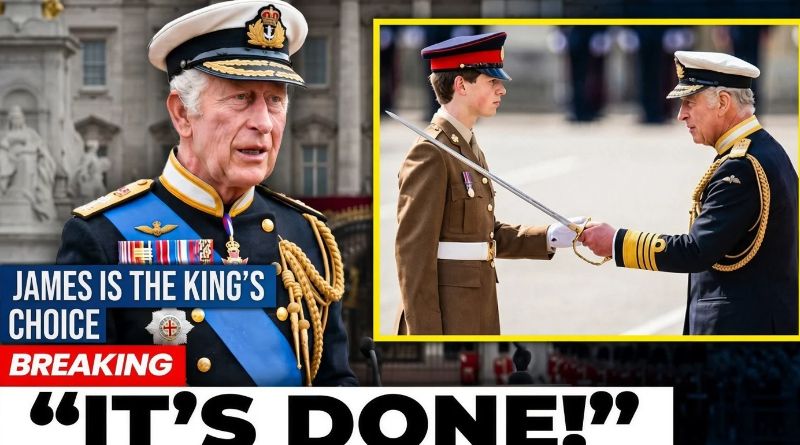
A dramatic royal commentary circulating online alleges that King Charles secretly stripped Prince Harry of his military honours and future royal standing, transferring both to his nephew James of Wessex. The account, presented as an exposé built on unnamed palace sources, says the transfer was locked in by letters patent signed on April 23, 2026, a sword ceremony at Windsor, a new coat of arms, and a Regency Amendment Bill replacing Harry with James.
The commentary frames Charles as engineering an irreversible legal and ceremonial trap so that Harry, Meghan, Archie and Lilibet are shut out of the future being built for James. James is cast as the quiet, loyal, self-controlled successor the King has been grooming in secret, while Harry and Meghan are portrayed as losing everything and left only to react emotionally.
A letters patent, a public ceremony and a bill in Parliament draw on three different sources of state power: the royal prerogative, the monarch’s personal authority, and elected lawmakers. The claim of irreversibility rests on combining all three so that no single challenge can unwind them.
The narrative begins in autumn 2022 at Gordonstoun, the Scottish boarding school once attended by Charles. The account claims a boy insulted James’s mother in a corridor, saying she “came from nothing and she’ll always be nothing.”
Gordonstoun is a deliberately spartan institution that has educated three generations of the royal family, including Prince Philip, Charles and Prince Edward. Charles himself is widely quoted by biographers as having described his time there as “Colditz in kilts.”
The account leans on that history to place the confrontation inside a world the King knows intimately. It claims James punched the boy, caught the boy’s second punch, held it, and said, “Don’t mess with my family again.”
He then dropped the boy’s hand and walked away, with witnesses said to be stunned into silence. The restraint — the ability to feel everything and still know exactly when to stop — is supposedly what caught Charles’s attention.
A brawl involving a member of the royal family at a well-known Scottish boarding school would ordinarily be fast-breaking news in the Scottish press. No contemporary report of such an incident exists in the public record, and the account names no witness and no other participant.
The story reached Charles, who arranged a private meeting at Windsor Castle. The account quotes him telling James, “The ones they come after are always the ones who matter.”
Over the next two years, according to the account, James received a speech coach, books on constitutional history and visits from senior royal aides. It says he told no one, not even his parents.
Secrecy of that kind would be striking for a teenager whose parents remain working senior royals. It would echo, however, the way heirs have traditionally been prepared for future roles, through private tuition and quiet briefings rather than public announcement.
In January 2026, Charles and James met alone at Balmoral. The account says James returned looking as though “something final and permanent” had been settled, and said nothing for three months.
At 4:47 a. m.
on April 23, 2026 — St George’s Day — Charles signed letters patent removing Harry’s military honours, according to the account. At noon in Windsor’s quadrangle, he handed James the demising sword of the Royal Marines and said one word: “Duty.”
The precise timestamp is the kind of detail that gives a narrative texture while remaining uncheckable. No palace official, cabinet minister or law office has confirmed it, and the account does not say who witnessed the signing.
The sword carries real history. Harry served as Captain General of the Royal Marines from 2017 until February 2021, when Buckingham Palace confirmed his honorary military appointments would not be resumed after he and Meghan stepped back from royal life.

The demising sword is the ceremonial blade involved when that role changes hands. In the actual record, the title reverted to the Crown after Harry’s departure and was later assumed by the King himself; the account takes that known history and gives it a sharper, more personal ending.
The narrative reaches back to 2020, when Harry reportedly held the same sword at Lympstone Commando in Devon and told an aide, “Not that sword. Not that one.”
No aide is named, and no contemporaneous source recorded the remark. The account claims the letters patent contained a “183-day doctrine”: any royal descendant spending fewer than half the days of the year on British soil would lose honours.
Because Archie and Lilibet live in California, the narrative says, they were in breach immediately. The threshold resembles the United Kingdom’s statutory residence test for tax purposes, a real rule with no publicly documented equivalent in succession law.
The Succession to the Crown Act 2013, the most recent major change in royal succession, deals with gender equality and marriage to Catholics, not residency. Charles also pushed a Regency Amendment Bill through Parliament, according to the account, removing Harry from the possible regent list and replacing him with James.
Under the Regency Act 1937, the regent is the first qualifying person in the line of succession. That practical rule makes William, and later his children as they come of age, the figures who actually matter in a regency.
Harry sits far down the list, so removing him would change little even if the bill passed. Harry’s lawyers are said to have a six-month window to challenge the letters patent.
Constitutional lawyers quoted in the account describe the combined battle as “cannot be done,” arguing that royal prerogative letters patent are nearly impossible to overturn. Courts have shown in recent years that prerogative powers are not entirely beyond review, and the Supreme Court’s 2019 prorogation judgment is the most famous example.
But a private legal instrument tied to royal honours would still face formidable barriers to challenge. The account says Harry was devastated, with the sword hitting him hardest.
It says that three days after the signing, Camilla hosted a dinner at Windsor, and that her son Tom Parker Bowles told her, “The wrong people always get the swords.” Camilla said nothing, the narrative continues.
Around the same time, Archie asked Meghan why other children were saying his name, and Meghan told him only that his grandfather had made a decision. James did not celebrate, according to the account.
He attended Commonwealth governance sessions, parade drills at Pirbright Barracks and evening talks with Charles, and made one unscripted comment at a Commonwealth reception about “shared service and a common history.” The account also claims the public is watching James with relief.

It offers no polling, no named reaction and no quoted public figures to support that assertion. The commentary identifies “three serious problems” facing James, even after the King’s move.
The first is parliamentary: the Regency Amendment Bill still needs to pass, support looks strong but could collapse, and without it James has the sword but “no real power behind it.” The second is a new coat of arms planned for St James’s Palace.
The account says it will include the exact military symbols stripped from Harry — the crossed sword and marine laurel — making the King’s decision permanently visible and potentially humiliating. The third, described as the most dangerous, is Meghan’s reportedly planned live television interview about everything Harry lost.
The palace strategy, according to the account, is for James to remain silent, keep working, and let the public see him as the steady one. Silence as a strategy has a royal tradition of its own: Buckingham Palace frequently declines to comment on private family matters.
The account’s version turns that ordinary reticence into a moral contest between a disciplined young duke-in-waiting and a media-driven exile. An interview of that scale has precedent.
Meghan’s 2021 conversation with Oprah Winfrey drew more than 17 million US viewers and caused days of palace crisis coverage. The Sussexes’ 2022 Netflix documentary spent weeks in the platform’s global top ten, and Harry’s memoir Spare sold 1.4 million copies in its first day of publication, according to its publisher.
Anything new about the Sussexes therefore arrives with a guaranteed global audience before a single fact is checked. Every element of the current account rests on unverified sources: unnamed palace sources, people close to the Sussex household, constitutional lawyers and royal staff.
No official confirmation exists from Buckingham Palace, the Sussexes, Prince Edward, Sophie, the Royal Marines or the Ministry of Defence. Letters patent granting royal honours are routinely published in the London Gazette, the official journal of record; no such instrument has appeared there.
Letters patent in the modern monarchy are not typically signed in secret at dawn, and the Privy Council and government legal advisers are ordinarily part of the process. The real James of Wessex is the younger child of Prince Edward and Sophie, born in December 2007 and therefore 18 in spring 2026.
When his father was created Duke of Edinburgh in March 2023, James took the courtesy title Earl of Wessex. James’s parents have their own long public record.

Edward worked in theatre and television before returning to full-time royal duties, while Sophie has often been described by palace officials as one of the monarchy’s most reliable working members. He has been raised largely outside the front rank of royal duties, appearing at state occasions and family events without the public profile of William’s children.
The account’s claim that he was groomed in secret for years cannot be checked against any public record. The commentary opens with the claim that James “succeeds as Duke of Cornwall and takes on the responsibilities for the Duchy of Cornwall.”
That collides with publicly known arrangements: the dukedom belongs to the eldest son of the sovereign, and Prince William has held it since September 2022. The headline promise that Archie and Lilibet have been removed from the succession is also at odds with the content, which concerns honours, a regency list and a coat of arms.
Altering the line of succession requires an act of Parliament, not letters patent. Nor does the account explain how James’s parents received the years of secret coaching, whether any school discipline followed the reported fight, or which network or date would carry Meghan’s alleged interview.
It names none of the palace sources on which the entire story rests. The wider context explains why the narrative has traction.
Since January 2020, when Harry and Meghan announced they would step back as senior royals, the story of their rupture with the monarchy has become one of the most commercially successful subjects in modern media. Enough real material exists — the Oprah interview, the Netflix series, the memoir — that unverified additions can slide into an established shape without sounding implausible.
For the current account to be accurate, a schoolyard brawl would have gone unreported, a constitutional bill would have passed without scrutiny, and two years of secret coaching would have left no trace in palace records. That is all possible, but none of it is evidenced.
What the account delivers is a clean story: a quiet hero on one side, a family shut out on the other, and a monarch whose quiet engineering saves the future of the throne. Whether any of it happened is another matter entirely, and on the public record there is no trace.